Showing posts with label energy. Show all posts

Tuesday, March 11, 2008

Gridlock on Electric Highways

When I suggested the need for a capital budget, these were the sort of problems I wanted to avoid (this one in my own backyard):

CONCORD, N.H.—Northern New England is turning to the sun, wind and waste wood for clean, renewable power, but there's a serious problem: the threat of gridlock on electricity "highways."

A prime example is New Hampshire's northern Coos County, where there are proposals to build renewable energy plants with roughly 460 megawatts of capacity -- two-thirds of the proposed renewable projects in the state -- to run over a transmission line that can only handle 100 megawatts.

The bottleneck is in Whitefield, the end of a transmission loop that runs through Berlin and Lost Nation.

Projects are approved on a first-come, first-served basis, and the first in line, Noble Environmental Power, stands ready to claim the entire 100 megawatts in 2009 for a wind park. That will leave the other proposals to wither and die if investors, electricity consumers or the government don't spend $200 million to upgrade 100 miles of line.

Even if the money were available now, the upgrade could take six years to complete, presenting investors with another hurdle -- time.

Last month, backers of a proposed 70-megawatt biomass plant in Groveton announced they had had enough, at least for now. Joshua Levine, project developer for Tamarack Energy, a partner in North Country Renewable Energy's plant, said the project is on hold despite the $1 million already spent on it.

The plant would burn wood chips, low-grade wood from logging operations and other clean wood readily available in the economically stressed region.

If we intend to bring new sources on line, we need to upgrade capacity. It's crazy to have $150 billion for economic stimulus on things we don't need and yet be cash starved on projects for which we've articulated a need.

Saturday, February 02, 2008

Your Pre-Super-Bowl Reading

From around the web:

  • Greg Mankiw lets New Hampshire Senate candidate Jay Buckey into the Pigou Club for proposing a gas tax of roughly 7 cents per gallon at current prices. Read about the National Security Levy here. It's as good a place as any for an aspiring politician to start.

  • Closer to home, Dartmouth's president, Jim Wright, will receive the Semper Fidelis Award from the Marine Corps Scholarship Foundation for his work on behalf of wounded veterans. Read more here.

Sunday, January 06, 2008

Perhaps a Microcosm of the Democratic Contest

I was unable to watch the candidate debates last evening, but Greg Mankiw provides what may be a microcosm of the contest on the Democratic side. The candidates were asked the following:

Al Gore favors a carbon tax. None of you have favored a carbon tax. Is it a bad
idea? Or is it just so politically unpalatable that you guys don't want to
propose it?

Greg diagnoses the responses of Governor Richardson as ignorant or disingenuous, those of Senator Obama as clear and honest (and correct), and those of Senator Clinton as vacuous. (Senator Clinton's response was so off topic that by the time the questioning got to Senator Edwards, the discussion had moved on to something else.) For Clinton's response, I might have chosen evasive, to link this to a broader theme.

I think that this exchange, which is a stark example of differences that over the past year have been more subtle, gives an indication of why Senator Obama may have appeal that crosses over the political center. I can respect his answer but not the other two.

And if clarity, honesty, and accuracy are important criteria in determining my vote, then I fully acknowledge that the Republican field doesn't go any deeper than Senator McCain. If he doesn't secure the nomination, then I may be looking for more options across the aisle come November.

Sunday, October 14, 2007

The Skeptical Pacificst, The Enthusiastic Environmentalist

I was not aware that one could be awarded the Nobel Peace Prize for environmental advocacy. Outsourced to New Hampshire's own Eagle Times:

There's no shortage of potential Nobel Peace Prize winners who might have more closely reflected Alfred Nobel's intent than Al Gore. What of the student protesters in Iran who dare to challenge the repressive theocracy led by Mahmoud Ahmadinejad? What of the Buddhist monks recently slaughtered by the repressive government of Myanmar? What of the Lebanese political leaders seeking to end Syrian domination of their country? Other nominees this year included a former Finnish president who worked for peace in a region of Indonesia and a Vietnamese monk who leads pro-democracy efforts.
Okay, on to a more constructive note.

I've seen two very interesting things this past week about climate change. The first was Bjorn Lomborg's op-ed in the Washington Post last Sunday. As Lomborg stresses, regardless of your views about each element of the climate change debate, there ought to be some consistency in your proposals about reform. To an economist, the consistency comes from being explicit about the problem to be addressed, the costs and benefits involved for each possible solution to that problem, and committing to the possible solutions that have the highest projected benefits relative to costs. Here's a good example from the op-ed:
The Kyoto Protocol, with its drastic emissions cuts, is not a sensible way to stop people from dying in future heat waves. At a much lower cost, urban designers and politicians could lower temperatures more effectively by planting trees, adding water features and reducing the amount of asphalt in at-risk cities. Estimates show that this could reduce the peak temperatures in cities by more than 20 degrees Fahrenheit.

Global warming will claim lives in another way: by increasing the number of people at risk of catching malaria by about 3 percent over this century. According to scientific models, implementing the Kyoto Protocol for the rest of this century would reduce the malaria risk by just 0.2 percent.

On the other hand, we could spend $3 billion annually -- 2 percent of the protocol's cost -- on mosquito nets and medication and cut malaria incidence almost in half within a decade. Malaria death rates are rising in sub-Saharan Africa, but this has nothing to do with climate change and everything to do with poverty: Poor and corrupt governments find it hard to implement and fund the spraying and the provision of mosquito nets that would help eradicate the disease. Yet for every dollar we spend saving one person through policies like the Kyoto Protocol, we could save 36,000 through direct intervention.
I'm not enough of an expert to know if the magnitudes check out, but this reasoning should be welcome in the debate over reform, as long as there remains a commitment to by all parties to getting the best reforms done. (It echoes other sensible voices here and here, though coming to different conclusions in some cases. I've made analogous points about reforms to Social Security here.)

The second thing was a presentation by Dan Reicher, a member of the Rockefeller Center's Board of Visitors, and now the Director of Climate Change and Energy Initiatives at Google.org. It's "RechargeIt.org" initiative is one of the coolest approaches to reshaping energy use and distribution that I've ever seen. Listen to Dan's podcast here.

Thursday, August 30, 2007

Some Good Ideas on Energy Tax Policy

Kevin Hassett and Gib Metcalf outline "An Energy Policy for the Twenty-First Century" in a recent AEI short publication. The policy prescription:

  1. An end to energy supply subsidies
  2. A green tax swap
  3. An end to the gas guzzler loophole and possible use of "feebates"
  4. Conservation incentive programs
I consider #2 to be by far the the most important element. I've got a higher tolerance for the carbon tax than most, I suspect, and don't particularly feel the need to make all of it revenue neutral. In particular, I'd make the carbon tax large enough to not just eliminate the gas guzzler loophole in #3 but the entire program of which it is part. Beyond that, I like #1 for making the government smaller (a hint to you conservatives out there) and, for the same reason, would wait for the first three to take hold to see how much of a need there is for #4.

Read the whole thing.

Saturday, August 18, 2007

Biofuels, Meet Opportunity Cost

Posted Thursday at New Scientist is a report of this article in Science magazine. Here's the intro:

It sounds counterintuitive, but burning oil and planting forests to compensate is more environmentally friendly than burning biofuel. So say scientists who have calculated the difference in net emissions between using land to produce biofuel and the alternative: fuelling cars with gasoline and replanting forests on the land instead.

They recommend governments steer away from biofuel and focus on reforestation and maximising the efficiency of fossil fuels instead.

The reason is that producing biofuel is not a "green process". It requires tractors and fertilisers and land, all of which means burning fossil fuels to make "green" fuel.

The ultimate irony would be chopping down forest land to plant biofuel crops. Consider the following:
The researchers also compared how much carbon would be stored by replanting forests with how much is saved by burning biofuel grown on the land instead of gasoline.

They found that reforestation would sequester between two and nine times as much carbon over 30 years than would be saved by burning biofuels instead of gasoline (see bar chart, right). "You get far more carbon sequestered by planting forests than you avoid emissions by producing biofuels on the same land," says Righelato.

He and Spracklen conclude that if the point of biofuels policies is to limit global warming, "policy makers may be better advised in the short term to focus on increasing the efficiency of fossil fuel use, to conserve existing forests and savannahs, and to restore natural forest and grassland habitats on cropland that is not needed for food."

They do admit, however, that biofuels made from woody materials such as prairie grasses may have an advantage over reforestation – although it is difficult to say for now as such fuels are still in development.

Putting energy reform in the hands of domestic agricultural producers seems like no better an idea than putting it in the hands of domestic petroleum producers.

Sunday, July 22, 2007

More CO2 Emission Comparisons

It seems like I'm not the only one making comparisons of greenhouse gas emissions from alternative processes. From our friends at the AFP, via TerraDaily in the aptly named "Eat a Steak, Warm the Planet:"

A kilogram (2.2 pounds) of beef causes more greenhouse-gas and other pollution than driving for three hours while leaving all the lights on back home, according to a Japanese study. A team led by Akifumi Ogino of the National Institute of Livestock and Grassland Science in Tsukuba, calculated the environmental cost of raising cattle through conventional farming, slaughtering the animal and distributing the meat, New Scientist reports in next Saturday's issue.

Producing a kilo (2.2 pounds) of beef causes the equivalent of 36.4 kilos (80.08 pounds) in carbon dioxide (CO2), the principal greenhouse gas, Ogino found.

Most of these greenhouse-gas emissions take the form of methane, released from the cow's digestive system.

That one kilo (2.2 pounds) of beef also requires energy equivalent to lighting a 100-watt bulb for nearly 20 days. The energy is needed to produce and transport the animals' feed.

A Swedish study in 2003 suggested that organic beef emits 40 percent less greenhouse gases and consumes 85 percent less energy because the animal is raised on grass rather than concentrated feed.

The study appears in full in a specialist publication, Animal Science Journal.
The full paper is here, if your library subscribes.

Comparing this to other sources of CO2 emissions, the 80 pounds of CO2 emitted is equivalent to that emitted by 4 gallons of motor fuel. It seems like we need to expand our systems of tradable permits to include enteric methane, or cut back on the product.

Saturday, July 07, 2007

Getting There Was More than Half the ...

For my second to last post about our trip to Hawaii, I wanted to point out something about energy consumption and CO2 emissions that I had not previously appreciated.

We flew from Boston to San Francisco (2704 miles) and then San Francisco to Honolulu (2398 miles), for a total of 5102 miles each way or 10204 miles total. How much fuel did we use (assigning us our per capita share for the plane as a whole)?

This page cites an FAA estimate of 48 miles-per-gallon-per-seat and notes that a gallon of jet fuel and a gallon of gasoline create about the same amount of CO2 emissions. This means that as a family, our share of the fuel used was about 4 x 10204 / 48 = 850 gallons. Let's compare that to two other fuel numbers around the Samwick household.

First, I estimate that we drive our cars no more than 1000 miles a month on average and get at least 20 miles per gallon on average, resulting in gasoline consumption of no more than (12 x 1000 / 20) = 600 gallons per year.

Second, we have used about 1100 gallons of #2 fuel oil to heat our home in each of the past few years. (What can I say, we like to be comfortable?) This page shows the CO2 emissions by fuel type, putting the fuel oil on a par with jet fuel, which are both a bit higher than gasoline.

One (glorious) trip to Hawaii used 75% of the fuel we use to heat our home or 140% of the fuel we use to power our cars, with corresponding amounts of CO2 emitted.

As it pertains to energy and environmental policy, this example shows how important it is to be comprehensive in our attempts to reduce oil demand. The most straightforward way to do that is to levy a tax on all fuel products derived from petroleum. It allows abatement to occur at every possible margin--by flying, driving, or heating less or by using technologies that are more fuel efficient.

Friday, June 08, 2007

The Soviet Collapse: Grain and Oil

I thought this article by Yegor Gaidar, based on his talk at the American Eneterprise Institute in November 2006, was an interesting and straightforward explanation for the end of the Soviet empire: complications from the need to import grain and the need to earn foreign currency by exporting oil. Consider this excerpt:

Yet one of the Soviet leadership's biggest blunders was to spend a significant amount of additional oil revenues to start the war in Afghanistan. The war radically changed the geopolitical situation in the Middle East. In 1974, Saudi Arabia decided to impose an embargo on oil supplies to the United States. But in 1979 the Saudis became interested in American protection because they understood that the Soviet invasion of Afghanistan was a first step toward--or at least an attempt to gain--control over the Middle Eastern oil fields.

The timeline of the collapse of the Soviet Union can be traced to September 13, 1985. On this date, Sheikh Ahmed Zaki Yamani, the minister of oil of Saudi Arabia, declared that the monarchy had decided to alter its oil policy radically. The Saudis stopped protecting oil prices, and Saudi Arabia quickly regained its share in the world market. During the next six months, oil production in Saudi Arabia increased fourfold, while oil prices collapsed by approximately the same amount in real terms.

As a result, the Soviet Union lost approximately $20 billion per year, money without which the country simply could not survive. The Soviet leadership was confronted with a difficult decision on how to adjust. There were three options--or a combination of three options--available to the Soviet leadership.

That's an interesting explanation. What are the lessons learned? From the conclusion:

In this latter case, it becomes evident that the "contract" between authoritarian rulers and their subjects--which secures stability by people's tolerance of the authorities and the authorities' noninterference in people's affairs--will need to be reexamined. Such reevaluation undermines the regime. The rulers, who for the longest time have insisted that their rule is the best, find it hard to ask for and get broad societal support in a moment of crisis. In this situation, the society has a habit of answering, "For many years, we were told that we are led to a ‘brighter future,' but now you would like us to tighten our belts. Instead, tighten your belts--or leave."

Russia does not need new upheavals. During the course of the twentieth century it saw enough of them. In this regard, the understanding by the elites and society that a real democracy is not an ideological dogma or something imposed by the West, but rather an important precondition for the stable development of the country, will finally give Russia the hope of escaping crises and cataclysms. This realization is vitally important for Russia's development in the next decades.

We may not be "fighting" the Cold War at present, but we are still cleaning up the battlefield.

Wednesday, May 30, 2007

Original Dumping

With this story, we have the within-country extension of the infamous Summers Memo of 1991.

Tuesday, May 15, 2007

Seeing RED To Be Green

Two interesting pieces today, both concerning carbon "sinks" and their ability to alleviate global warming due to carbon release.

First up is a story on "Reducing Emissions from Deforestation:"

Tropical deforestation, which releases more than 1.5 billion metric tons of carbon to the atmosphere every year, is a major contributor to global climate change. Recognizing this, a group of forest-rich developing nations have called for a strategy to make forest preservation politically and economically attractive. The result is a two-year initiative, dubbed "Reducing Emissions from Deforestation" (RED), launched by the United Nations Framework Convention on Climate Change.

So is 1.5 billion metric tons per year a lot or a little? Continuing its summary of the study:
[T]he authors found that reducing deforestation rates by 50% over the next century will save an average of about half a billion metric tons of carbon every year. This by itself could account for as much as 12% of the total reductions needed from all carbon sources to meet the IPCC target of 450 parts per million of carbon dioxide in the atmosphere by the year 2100.

It also finds:
[C]omputer models that link climate effects to changes in the carbon cycle have predicted that tropical forests will survive and continue to act as a "sink" by absorbing carbon, provided that emissions can be kept under control . The efficiency of the tropical forest as a carbon sink might in fact diminish over time, but the authors expect that it will not disappear completely.

A second article considers the role of the oceans in absorbing carbon from the atmosphere and the reverse:
A University of Colorado at Boulder-led research team tracing the origin of a large carbon dioxide increase in Earth's atmosphere at the end of the last ice age has detected two ancient "burps" that originated from the deepest parts of the oceans.

The new study indicated carbon that had built up in the oceans over millennia was released in two big pulses, one about 18,000 years ago and one 13,000 years ago, said Thomas Marchitto and Scott Lehman of CU-Boulder's Institute of Arctic and Alpine Research, who jointly led the study. While scientists had long known as much as 600 billion metric tons of carbon were released into the atmosphere after the last ice age, the new study is the first to clearly track CO2 from the deep ocean to the upper ocean and atmosphere and should help scientists better understand natural CO2 cycles and possible impacts of human-caused climate change.

As a non-specialist, it does seem like the public debate about global warming seems to focus quite a lot on how much carbon is introduced into the atmosphere, rather than how much is taken out.

Tuesday, April 24, 2007

Congestion Pricing in Manhattan

I applaud Mayor Bloomberg for proposing congestion pricing in Manhattan as part of his Earth Day initiatives, patterned after a similar system in London. From The New York Times on Sunday:

The proposal that is sure to attract the most attention, and possibly objections, is one to impose the $8 fee on car drivers, and $21 for truck operators, to drive in Manhattan south of 86th Street.

The mayor said congestion on the city’s streets is the source of many of the city’s health, environmental and economic problems.

“We can’t talk about reducing air pollution without talking about congestion,” he said.

“As our city continues to grow, the cost of congestion to our health, to our economy and to our environment are only going to get worse,” he said. “The question is not whether we want to pay, but how do we want to pay — with an increased asthma rate, with more greenhouse gases, with more wasted time, lost business and higher prices. Or do we charge a modest fee to encourage more people to take mass transit.”

The fee the mayor is proposing would only be imposed during the week, between 6 a.m. and 6 p.m.. And motorists driving the major highways along Manhattan’s east and west sides would not be fined, so it would be possible to go from Brooklyn to Harlem along Franklin D. Roosevelt Drive without entering the zone.

The article contains other information about the implementation that suggest that it has been reasonably well thought out. But this doesn't stop the critics from making a raft of self-serving claims. Let's take a look at a few:
State Assemblyman Richard Brodsky said he opposed the mayor’s proposal for a congestion fee because it is a regressive tax.

“The middle class and the poor will not be able to pay these fees and the rich will,” said Mr. Brodsky, who is chairman of a committee that oversees the Metropolitan Transportation Authority. “There are a lot of courageous things in the mayor’s package, but this one is not very well thought out.”

According to this logic, all prices for services not linked to income are regressive, since the rich can more easily pay them than the poor. It might technically be true, but it isn't particularly helpful. Besides, when I go to Manhattan, I see the middle class and the poor on the subways and buses, not their own cars.

Here's some more, of the more nakedly self-serving variety:
Clayton Boyce, a spokesman for the American Trucking Association, a national industry group, told The Associated Press, “It will be a real problem for operations for trucking companies and shippers, including all the retailers in Manhattan, which is substantial.”

“And all the people who get FedEx and UPS deliveries will have problems and will bear extra expense, so we definitely see problems with it,” he said.

It's time to give Mr. Boyce a refresher course in microeconomics. Start by considering what his answer might have been last week to the question, "What is the biggest problem your industry faces in providing excellent service to lower Manhattan?" Based on what I've seen on those streets, my answer would have been "congestion." So the mayor has proposed to tax the thing that has been encumbering the trucking industry, and its spokesman is complaining because his clients will need to pay the tax in proportion to the congestion they cause.

Think of it by the numbers. How many packages are on the typical FedEx truck in Manhattan? If it were 210, then the extra expense would be a dime per package. That's trivial. How does $21 compare to the total value of each truck's cargo in a given day? It has to be tiny. And look at what the FedEx truck drivers get in return--fewer passenger cars clogging up the city streets where they need to make pickups and deliveries. They waste less time and less gas. It doesn't take much abatement of that wasted time and gas to make back the $21 per truck. The trucking industry should be this proposal's biggest supporters.

Monday, October 09, 2006

Republicans and Gas Taxes


Daniel Gross writes about the "emerging" consensus of economists in favor of higher gas taxes. I thought the graphic above was quite telling, about the U.S. in relation to other western countries.

The word "emerging" is in quotes, referencing a theme of the article, which is that it is much easier for people who have worked inside a Presidential administration to advocate for politically unpopular ideas when they are on the outside. That's true but only to a point. It's not that Greg Mankiw ever said anything other than what he now says about the gas tax while on the inside. It's that the President sets the framework for all policy outcomes--not the CEA--even on economic issues. CEA, like every other part of the administration, works to generate the best outcomes within that framework. And if the President is not interested in a gas tax, then it becomes a very short conversation.

Gross quotes me, from a telephonoe conversation last week, as follows:

What gives? Clearly, there is an emerging consensus among economists — right and left — that the nation would be better off, geopolitically and economically, if Americans used less gasoline. “Given the role that imported oil plays today, you can’t continue to be a responsible economist and not talk about ways to reduce that dependence,” Mr. Samwick said. “If you are concerned about the external consequences of imported oil, then you should raise the cost of it.” And free-market economists view a higher gas tax as a more elegant solution than, for example, raising auto efficiency standards.
So it's not that the consensus is emerging because it is new--it is emerging because there is more of an audience for it.

Another issue that is relevant here is that I would propose that the additional gas tax be done in a revenue-neutral way: returning the proceeds in aggregate in the form of progressive cuts to the income tax. Then fix the long-term deficit by raising the whole schedule (again, progressively) of income tax rates. One problem that the President would have if he advocated higher gas taxes without fixing the long-term deficit problem is that he would be accused of paying for his income tax cuts with higher gas taxes. Not a place he wants to be.

Tuesday, August 08, 2006

Conservation on the Lakes

I was surprised but quite unsympathetic to learn how much of an impact higher gas prices have on owners of pleasure boats:

Even with the higher prices, boaters are going out, lest they waste what can be a huge investment.

“It’s a short season,” said Todd Heimlich of Burlington “You’ve paid for the boat - and you’re not going to use it?”

Heimlich and his brother, Mark, from Wakefield, were docking in Paugus Bay in Laconia after a spin this week in their Baja, a gas guzzler with twin 425-horsepower engines.

Mark Heimlich said they’ve noticed some changes, including more boats carrying more people.

“They used to go out on their own, but now four couples are sharing the gas and going out,” he said.

Their boat has a 225-gallon tank, meaning a fill-up at $3.95 pushes $900. Todd Heimlich said running six hours a day, they can burn a tank in a weekend.

The brothers and the Valitons also said they see people anchoring after short boat rides rather than taking long cruises as they did in the past.

Nice to see they're economizing

Sunday, May 14, 2006

Gas Prices in Perspective

I thought Jim Borgman of the Cincinnati Enquirer made a good point with this recent cartoon.

For some of his earlier work, see this archive.

Wednesday, May 03, 2006

You Pay Your Money, You Take Your Chances

I finally decided to go in for TimesSelect. I am greeted by Tom Friedman's column, "Let's (Third) Party," where I read this gem about gasoline prices:

Like someone who will tell the truth: The only way Americans are ever going to enjoy relatively cheap gasoline again is if we raise the price now with a gasoline tax— and fix it at that higher level for several years — so investors know that it is not coming down, and therefore it makes economic sense for them to make the long-term investments in alternative, renewable sources of energy. That is the only way to break our oil addiction and ultimately bring down the price.

That's a fascinating "truth." Note that he is not writing here about the externalities associated with our dependence on oil--he is writing about the direct consumption of it through gasoline. So in order to have cheap gasoline later, we should insist on having expensive gasoline today, even if the price of gasoline would fall in the interim. That is beyond silly.

I understand that post-9/11, Friedman has been frustrated by the failure of the President to launch a national initiative about anything, but particularly about our energy consumption. I share much of that frustration. I even advocate for a higher gasoline tax (because of the externalities associated with its consumption and instead of idiotic CAFE standards). I also wish more people understood Brad DeLong's very cogent point that the correct side of this debate to be on is to have people face the market price of gasoline and certainly to do nothing to shield them from it (again because of the externalities). But Friedman is doing the same sort of pandering as the politicians he is criticizing when he holds out the promise of a future with cheaper gas as the rationale for his proposal.

It doesn't have to be complicated. Estimate the monetary cost of the negative externalities associated with gasoline use, set the appropriate tax, and then do nothing else. The market price then sends the correct signal to investors about how to take advantage of new opportunities in alternative energy.

Monday, November 07, 2005

Gas Tax Redux

A few months ago, I posted a couple of times on my preference for a gas tax compared to the CAFE standards. Today, I happened across two papers by Professor Jayanta Sen that are, at the very least, quite provocative. They focus on ways that the U.S. could make itself better off by (in the first paper) taxing an imported good that has a relatively inelastic supply and by (in the second paper) forming an international cartel of importing countries, to offset the market power of OPEC. Here are the abstracts, with links to the full papers at SSRN:

A Tax to Save the US $100 billion a Year and Solve Global Warming?

The position of the current US administration is that moves to reduce consumption of gas (like the Kyoto Treaty), will harm the US economy. On the contrary I show that a tax on crude would transfer wealth of $100+ billion a year from foreign governments to the US consumers, thus providing a major economic stimulus to the economy while at the same time reducing consumption of gas. Over the past decade crude oil prices have increased from $12 (1998) to over $65 a barrel. The amount of net oil exported to [by] importing countries is about 28 million barrels a day. With 1998 prices as a reference, this translates to an additional wealth transfer of $1.32 billion a day, or $480 billion a year. If the supply of oil is inelastic, then an increase in tax by the governments of importing countries would push up oil prices and decrease the wealth transfer. For a range of demand and supply elasticities that I study, the wealth transfer savings for the United States (which has about one-third of global oil imports) should be in the range of $108 to $152 billion a year. The new tax revenues to the US government from tax on imported oil should be $160 billion to $250 billion a year. This money can be returned to the US consumers as a lump sum, thus providing the economic stimulus. The reduction in crude oil consumption ranges from 7.13% to 10.30% while providing a stimulus (defined as additional purchasing power to consumers) to the economy of $95 billion to $133 billion a year.

Oil at $10 a Barrel and $200 Billion Savings a Year for the U.S.: Benefits to the U.S. from a Buyer's Cartel

In the international oil market, the producers are cartelized, whereas the buyers are fragmented. As standard economic analysis suggests, this results in a greater share of the surplus for the producers. The cost of production for a barrel of oil to the producers is approximately $8, whereas the recent price is $65. A buyer's cartel could be formed by the governments of the major oil importing countries like the U.S., Japan, Germany, China, India etc. All oil sold in these countries would have to pass through the buyer's cartel. The buyer's cartel could negotiate a price with the oil exporting countries, say $10 a barrel (which should be a sufficient markup over production costs). After purchasing oil from the producing countries, the buyer's cartel would release the oil in the market and let demand determine the price. If current demand conditions remain unchanged then the price would still remain at $65. However, this would reduce the effective price to the citizens of the importing countries to $10 a barrel as their governments would earn a profit of $55, which could be used to reduce taxes or pay for programs like Social Security. For the U.S. (which imports 10 million barrels a day) the savings would be $55 x 10 million x 365 = $200.75 billion a year.

Blogsearch Technorati

Monday, September 26, 2005

Fuel Economy and Safety


Karen Lundegaard has an intereting article today in the Wall Street Journal about new thinking about fuel economy and safety.

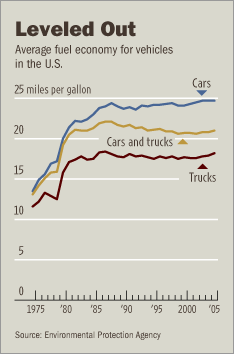
The story presents a graph from the EPA showing fuel economy over time for cars, trucks, and then their combination. It makes the point well from an earlier discussion of the CAFE standards (here, here, and here). Even though fuel economy per vehicle may have been flat to increasing for both cars and trucks, the shift of more drivers into the less efficient trucks has caused the overall fuel efficiency to fall.

The main new point in the article is to point out that some new research takes issue with the presumption that improvements in fuel economy would come at the expense of safety:


For decades, whenever the federal government leaned on auto makers to improve fuel efficiency, the industry had a ready response: Research showed that lighter, more fuel-efficient vehicles weren't as safe as their heavier, gas-guzzling cousins. Even shedding as little as 100 pounds could lead to a serious increase in traffic fatalities.

The result has been a virtual standstill in fuel-economy improvements for cars, trucks and sport-utility vehicles over the past 20 years.

Now a wave of new studies and technologies -- strong, light materials, better airbags and smarter designs -- are beginning to break the logjam. The upshot: A big shift in government thinking that is paving the way for regulators to revamp fuel-economy rules for SUVs and pickup trucks for the first time in three decades.
I'm glad for the use of research on the other side of a long-held presumption, but I'm not sure the article gets the argument right. Later, we have:

For years, the accepted wisdom in the car industry held that, all things being equal, heavier vehicles are always safer when two vehicles crash. New studies highlight how other factors -- including a car's size, body design and advanced technology -- can do much to counteract the weight issue.

The newer studies also have homed in on the downside of weight: While a heavy vehicle protects its occupants in an accident, it inflicts more damage to those it hits. That means reducing the weight of the biggest vehicles could yield dividends in both fuel consumption and safety.

All of this has contributed to a rethinking of the fuel-economy regulations from the National Highway Traffic Safety Administration. Last month, NHTSA crafted new "Corporate Average Fuel Economy" rules, or CAFE, for light trucks that aim to balance safety and fuel efficiency. The old rules set an average weight target for an auto maker's entire fleet of cars or trucks, encouraging car makers to sell lots of small fuel-efficient vehicles at sometimes unprofitable prices, so they could keep selling their more profitable gas guzzlers.

The article fails to recognize two issues. First, there is a big difference in safety risks that a vehicle poses to its own occupants and the risks that a vehicle poses to occupants of other vehicles. There is a compelling reason for the government to be involved in the latter, far more than would exist for the former. Without government involvement, drivers of heavier vehicles would not bear the costs they impose on other drivers. (It's not clear that they do so now, apart from states without no-fault insurance requirements.)

Second, the flaw in the old system is the presence of multiple categories for fuel economy standards, with lower standards for some groups. That remains in the new system and can be expected to have the same consequences for fuel economy. Exactly what has changed that would arrest the slide in fuel economy shown in the graph above? Only the increase in the standard for trucks as a whole--not the presence of categories.

Consumers can make their own choices about how much safety they want in their own cars. The government can confine itself to providing accurate information about safety. The continued commingling of irrelevant own-occupant safety concerns with legitimate concerns about fuel economy makes the policy less useful than an ideal CAFE or a gas tax.

Blogsearch Technorati

Wednesday, August 31, 2005

Cleaning Up the CAFE

Just a few final comments on CAFE, before moving on to other topics. Kevin Drum argues, in a rebuttal to Matthew Yglesias, that the CAFE standards do what they were designed to do.

His evidence is a National Academy of Sciences study that tracks an increase in the average fuel economy of cars in the wake of CAFE. I cannot point out the weakness in this argument any better than a commenter on his site did (here and here)—it appears to ignore the CAFE-induced shift to light trucks with lower fuel economy requirements.

Drum’s article also points out that the NAS study also suggested the use of a tradable credit system, as I suggested in my earlier post. Good to know that this is concept is now accepted by a broad range of the policy community.

I still prefer the gas tax, but I am not as resolute as I was a few posts ago. If we are going to stick with CAFE, I'd recommend that it have the following elements:

  1. One standard, covering every passenger vehicle
  2. Tradable credits, to enhance efficiency
  3. Stiff penalties for failing to meet the standards
  4. A very agressive schedule of increases, legislated today for future years

Professor Ted Gayer Guest Blogs on CAFE

Ted Gayer, a former colleague of mine at CEA, an Associate Professor of Public Policy at Georgetown, and a Visiting Scholar at AEI, takes a turn guest-blogging on CAFE:

Since I’ve done some research on light trucks, Andrew has graciously allowed me to throw in my two cents on the new CAFE standards. I’ll take the invitation as an indication that he has forgiven me for any headaches I caused him while working under him at the CEA.

As Andrew pointed out, one of the odd things about the new CAFE standards is that they create six categories of light trucks (based on wheelbase multiplied by track width), with the standards becoming more lax for the larger categories. So now there’s an incentive to build larger light trucks. (To DOT’s credit, by reducing the discrepancy between the CAFE standard for cars and the standard for small light trucks, they did reduce the incentive to make the latter rather than the former.)

Why would DOT want to provide an incentive to build larger light trucks? One reason is because of John Graham, who is the Administrator of the Office of Information and Regulatory Affairs (the OMB office that oversees regulatory matters). John has long argued that increasing CAFE standards leads to down-weighting, and that down-weighting leads to more traffic fatalities (see his 1989 paper with Robert Crandall in the Journal of Law and Economics [link via JSTOR]). The Crandall and Graham paper finds evidence of down-weighting, and they link these findings to work by Leonard Evans [link via ScienceDirect] which suggests lighter cars lead to more fatalities.

All of this is eminently plausible, yet I have a few quibbles with using this work as a justification for the structure of the new CAFE standards. First, the original Evans work (from the early 1980s) was focused on cars of different weights, and did not consider light trucks (there were so few data points back then for light trucks). While it may be true that two light cars crashing results in more fatalities than two heavy cars crashing, this is not directly generalizable to the case of two light trucks (which are heavier and larger) crashing. But my bigger quibble is that the Evans research examines the total fatalities that occur, given that a crash has taken place. In a world of only cars, this type of analysis makes sense, because there is no a priori reason to think that heavy cars are more crash prone than light cars. But given the higher center of gravity of many light trucks, and the different and conflicting sightlines they present, there is some concern that light trucks are indeed more crash prone than cars.

I looked at this issue in my 2004 Journal of Risk and Uncertainty article. First, I confirm the findings of Crandall and Graham as applied to light trucks. That is, given that a crash has occurred, we can expect more fatalities if the crash involves two cars than if it involves two SUVS. (Interestingly, I find that a crash of two pickups is worse than a crash of two cars.) Another way of saying this is that the safety advantage of being in an SUV rather than a car dominates the additional risk that the SUV rather than a car poses to the other driver in the crash.

But then I estimate the additional crash risk posed by light trucks relative to cars. This isn’t an easy task, since one must consider the likelihood that more reckless drivers select into light trucks relative to cars. I address this by using snow depth variation by states. It turns out that states with higher annual snow depth tend to have more annual light truck driving than car driving. I then use this variation to look at relative crash frequencies in summer months (when snow depth doesn’t play a part). I find that, indeed, the additional crash risk of light trucks cancels out the safety advantage they pose when in a crash.

So what’s it all mean? By creating an incentive to build larger light trucks, the new CAFE standards will likely not achieve their goal of protecting drivers’ safety. Aside from this, I should point out that I agree with Andrew: the pertinent regulatory issue is not the total fatalities resulting from the mix of vehicle types. A consumer can decide for herself how much to spend for a safer vehicle. What she can’t decide is how threatening a vehicle other people should buy.

I do think there was another reason for the structure of the new CAFE standards. U.S. automakers make larger light trucks than their foreign competitors, so a uniform light truck CAFE standard hurts domestic automakers. I think this gets at Andrew’s concern that CAFE standards are not transparent: here’s an example where they can be used for protectionist purposes. So I throw my hat to the politically implausible goal of scrapping CAFE and replacing with a higher gas tax.

Thanks to Ted for guest blogging. When in doubt, consult an expert!

Other blogs commenting on this post